
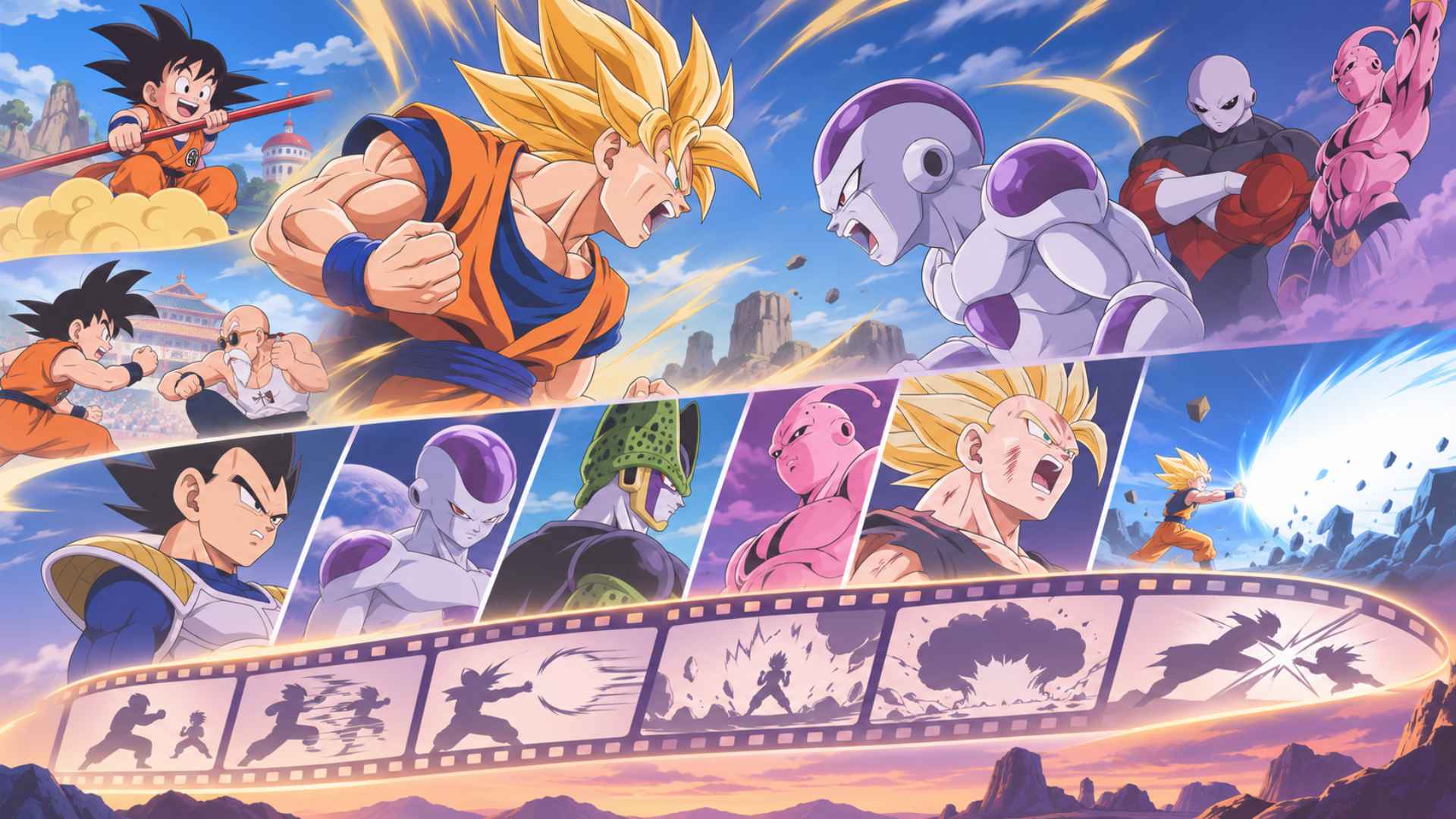
Akira Toriyama’s Dragon Ball manga began publication in Weekly Shonen Jump in 1984. Its first television adaptation, Dragon Ball, debuted in 1986 and ran for 153 episodes. Toei Animation followed it with Dragon Ball Z, broadcast in Japan from April 26, 1989, to January 31, 1996, across 291 episodes. Although the Japanese manga retained the Dragon Ball title, the television division marked a shift toward alien enemies, greater destructive power, and conflicts that extended far beyond martial arts tournaments.
Dragon Ball Z did not invent exaggerated attacks, extended duels, or supernatural combat. Earlier action anime had already established many related conventions. Its contribution lay in the repeated combination of those elements within a recognizable screen language. Fast exchanges alternated with long pauses, energy attacks carried visible consequences, and individual battles became major narrative events. The result provided a widely recognized reference point for the presentation of combat in later action series, especially adaptations of serialized shonen manga.
From Manga Panels to Animated Combat
A manga artist controls action through panel size, composition, and the distance between moments on a page. Animation introduces fixed screen time, sound, movement, and editorial choices. In Dragon Ball Z, exchanges of punches could appear as rapid sequences of impacts, while a sudden cut to a distant landscape established the scale of the encounter. Close ups emphasized a character’s reaction before the action returned to a wider view. These choices made fights legible even after the characters gained the ability to move and attack at extraordinary speeds.
The series also established a familiar contrast between movement and stillness. Opponents could cross a battlefield almost instantly, then face one another through extended shots before the next strike. Speed lines, flashes, dust clouds, damaged terrain, and sharp changes in framing conveyed forces that static manga panels had suggested through illustration. Voice performances and Shunsuke Kikuchi’s score supplied another layer of tension. Not every episode maintained the same visual complexity, but the recurring techniques gave the series a consistent identity across different story arcs and production teams.
Energy Attacks and Transformations as Visual Events
Dragon Ball Z treated power as something the audience could see before a blow landed. Characters gathered ki, produced distinct auras, and released attacks such as the Kamehameha. Scouters introduced numerical power levels during the Saiyan and Namek portions of the story, although the narrative also demonstrated the limits of those readings. These devices offered immediate cues about danger and relative ability. A character’s posture, surrounding effects, and the reactions of nearby fighters could establish the seriousness of an encounter without a lengthy explanation.
The confrontation between Goku and Frieza on Namek illustrates the connection between spectacle and character development. After Frieza kills Krillin, Goku becomes a Super Saiyan, a transformation that changes his hair color, facial appearance, aura, and combat ability. The original manga presented this event in 1991; the anime gave it duration through voice, color, sound, and successive shots. Later, Gohan’s Super Saiyan 2 transformation during the Cell Games introduced a distinct electrical aura. These visual changes communicated turning points in the plot rather than serving as interchangeable effects.
The Legacy of Long Battles and Escalating Stakes
Extended confrontations became another distinctive feature. The conflict with Frieza involved several fighters, multiple forms, reversals, and a final struggle against the destruction of Namek. The Cell Games placed an organized contest around an increasingly personal conflict, while the final clash between Gohan and Cell used opposing Kamehameha attacks to express physical force and emotional support. Each major exchange affected the situation that followed, from a fighter’s injury to a shift in the balance of power. A decisive attack therefore carried the weight of events established across many episodes, rather than functioning as an isolated display of force.
This approach carried a cost. A weekly television series adapted material from a manga that was still in publication, so new episodes sometimes expanded exchanges, prolonged reactions, or added scenes absent from the original chapters. Those additions could develop suspense, but they also slowed individual confrontations. Dragon Ball Z Kai, first broadcast in 2009, revised the earlier footage and reduced much of the extra material. Toei Animation lists 167 episodes for its international release, compared with 291 for the original series. The comparison helps distinguish the underlying story from the pace chosen for its first television presentation.
The series’ wider influence has direct support in comments from later creators. Masashi Kishimoto, author of Naruto, has acknowledged Dragon Ball as an influence on his story development. Later action anime also feature recognizable power states, distinct combat abilities, extended rivalries, and decisive attacks tied to character growth. Such similarities do not establish that every visual device originated with Dragon Ball Z; earlier productions and individual animation directors contributed to the genre as well. Its lasting contribution was the consistent combination of anticipation, speed, scale, and emotional consequence. That approach gave later productions a familiar model for translating illustrated battles into screen events without separating spectacle from the story.